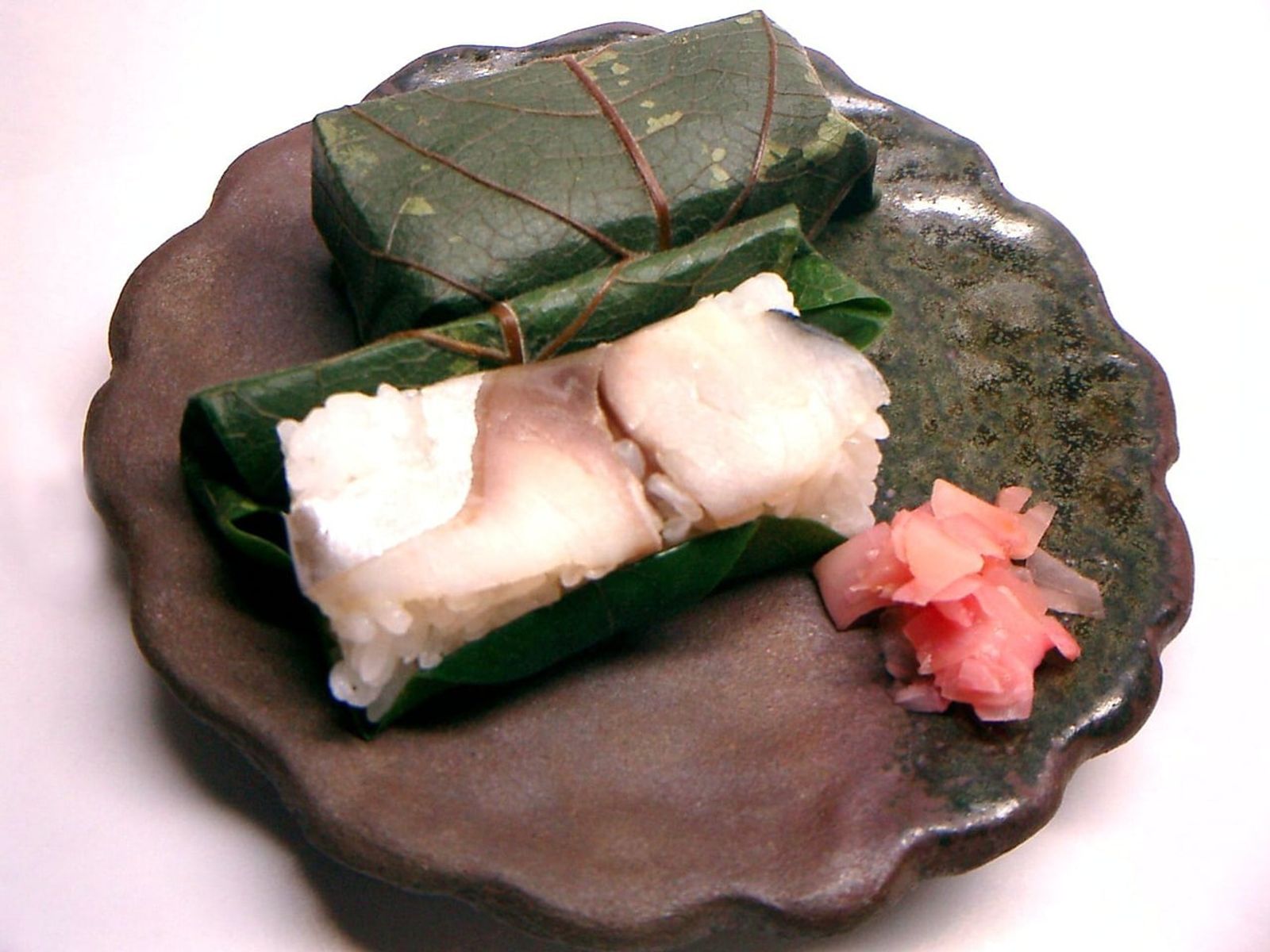
Mackerel kakinoha-zushi with the leaf opened · Photo: Tomomarusan / CC BY-SA 3.0 (Wikimedia Commons)
 JapanNara
Kakinoha-zushi: How Landlocked Nara Made Mackerel Sushi Its Signature
Nara has no coastline, yet its best-known local dish is mackerel sushi. Here is the story of salted mackerel carried over the mountains, what the persimmon leaf is for, how to eat it and where to find it.
Nara's "Mackerel Road"
Nara is a landlocked prefecture ringed by mountains, so sea fish were long a luxury. Even so, the dish most often named as Nara's local specialty is sushi topped with mackerel: kakinoha-zushi (柿の葉すし), persimmon leaf sushi. The secret lies in the sea to the south, off the Kii Peninsula. According to Japan's Ministry of Agriculture, the East and West Kumano Kaido roads running north to south through southern Nara were also called Yamato's "mackerel road" (saba kaido), because mackerel caught in the Kumano Sea were salted and carried over the mountains along them. The salted fish reached Gojo and Yoshino, an area famous for persimmons, and that meeting of mackerel, rice and persimmon leaves is said to be where kakinoha-zushi began.
When Did It Begin? The Sources Disagree
The most widely told story dates to the mid-Edo period. Fishermen in Kishu (today's Wakayama Prefecture), struggling with heavy taxes, salted summer mackerel to raise cash and carried it over the passes to villages along the Yoshino River, where the fish became a treat for summer festivals. Some accounts say it came upriver by boat on the Kinokawa and Kumano rivers instead. The dates, however, vary by source. The Ministry of Agriculture's traditional food guide mentions both a theory that it was made as early as the Nanboku-cho period (14th century) and accounts of it being produced in the 1800s, and another theory says it grew out of preserved food or soldiers' rations. At first it was closer to narezushi, fermented without vinegar; it is said to have become vinegared sushi as we know it after brewed vinegar spread in the mid-Edo period.
Why the Persimmon Leaf, and Can You Eat It?
To make kakinoha-zushi, thin slices of mackerel are placed on bite-sized portions of vinegared rice and wrapped in persimmon leaves. The parcels are packed tightly into a wooden tub, covered, weighted with a stone and left for about a night. The leaf is there for a reason. Persimmon leaves are said to have antibacterial, preservative qualities, so wrapped sushi keeps well for a few days. The leaf's aroma also seeps into the rice and fish. Leaves from astringent persimmon trees are said to be softer and better suited, and in Gojo and Yoshino, a persimmon-growing area, they were easy to come by. The question visitors ask most: no, you do not eat the leaf. Peel it off and eat only the sushi. The leaf is a wrapper for flavor and keeping.
From Festival Feast to Station Snack
Mackerel, salt and rice were all precious, so kakinoha-zushi was not everyday food but a hare no hi dish for festivals and celebrations. In Gojo and Yoshino, families made it at home around the time rice planting was done, ahead of the summer festivals, with children helping out. Some households still make it for festivals today. What made it famous was the railway. Once trains arrived and station kiosks began selling it, it became known as an ekiben (station lunch), then grew popular at department store food fairs and ekiben events, and production rose with it. A salmon version appeared in the Meiji era, and today mackerel and salmon are the two standard fillings.
How to Eat It and Where to Buy It
Because the flavors of the mackerel and leaf soak into the rice while it rests under weight, kakinoha-zushi is normally eaten after resting overnight rather than straight away. It is eaten at room temperature, not heated: pick one up, peel off the leaf and eat it in a bite or two. Besides mackerel and salmon you may find sea bream, grilled conger eel or shiitake, and in Kawakami village deep in the Yoshino mountains the old style made with salted mackerel and no vinegar is said to still be the norm. In Nara city it is easy to buy in the shopping streets and souvenir shops around Kintetsu Nara and JR Nara stations, and it is sold widely in its home area of Gojo and Yoshino, including Mount Yoshino. Note that Kaga in Ishikawa Prefecture and Chizu in Tottori Prefecture also have kakinoha-zushi, with the same name but different fish and shapes.