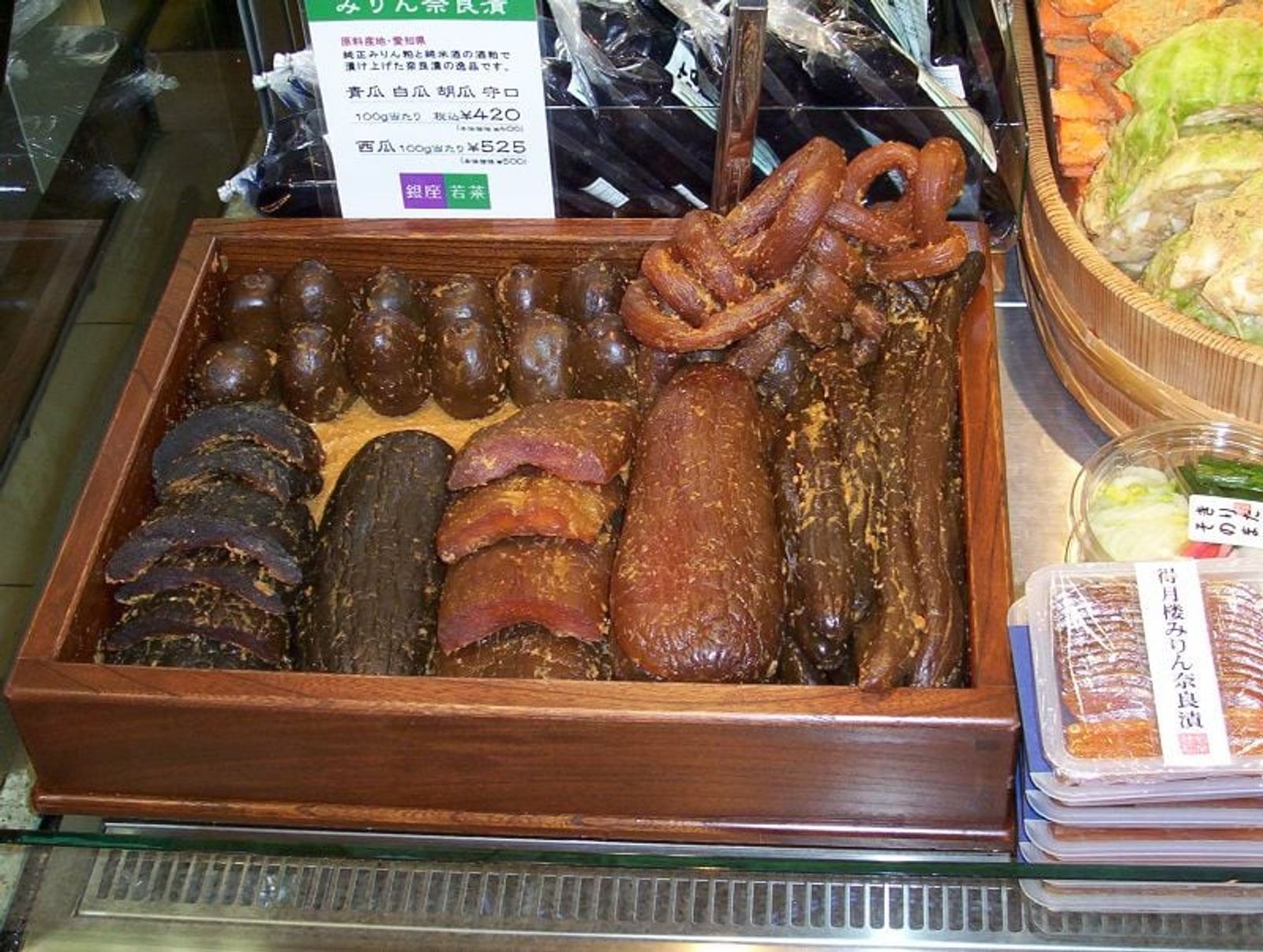
Dark, long-pickled narazuke on display at a pickle shop · Photo: daveyll (David Loong) / CC BY-SA 2.0 (Wikimedia Commons)
 JapanNara
Narazuke: Nara's Sake-Lees Pickles, Traced Back to the Heijo Palace Era
Narazuke are vegetables salted, then moved again and again into fresh sake lees. Here is the story from Nara-period wooden tablets to the origin of the name, how to eat it, and the common question about alcohol and driving.
What Narazuke Is
Narazuke (奈良漬) are made by first salting vegetables such as shirouri (a pale Oriental pickling melon), cucumber, young watermelon or ginger, then burying them in sake lees, the paste left over from brewing sake. The key is that it is never done just once: the vegetables are moved into fresh lees again and again so the flavor builds slowly, and lees from the previous year may be reused. Most narazuke sold today are a translucent amber, but the traditional method, pickling for four years to more than a decade, turns them almost black. The taste is sweet and salty with the deep aroma of sake lees, and a good piece keeps a crisp bite.
A Pickled Melon on a Heijo-kyo Wooden Tablet
Narazuke's roots are said to reach back to Heijo-kyo, when Nara was Japan's capital. Among the wooden tablets (mokkan) excavated from the site of Prince Nagaya's residence in the Heijo-kyo ruins is a shipping tag for goods offered to the household that reads kasuzuke uri (加須津毛瓜), melon pickled in lees, and it is often introduced as narazuke's ancestor. According to Japan's Agency for Cultural Affairs, the dated Nagaya tablets fall between 710 and 716. Later, the Engishiki, a code of regulations completed in 927, also records melons pickled in sake lees. Records like these are why narazuke is often introduced as a pickle with some 1,300 years of history.
The Name "Narazuke" and a Shogun's Favorite
The name narazuke is said to appear first as ナラツケ in 1492, in the Yamashina-ke Raiki, the diary of a noble household. The 1603 Vocabulario da Lingoa de Iapam, a Japanese-Portuguese dictionary compiled by missionaries, lists it as a kind of pickle from Nara, so by then the name was clearly well known. The usual explanation for the name is that Nara was a center of sake brewing. In the Keicho era (1596-1615), at the start of the Edo period, an herbal doctor named Itoya Sosen of Nakasuji-cho in Nara is said to have sold shirouri pickled in lees under the name narazuke and won a reputation for it. One story says he presented it to Tokugawa Ieyasu during the Osaka campaigns, Ieyasu loved it, and Sosen gave up medicine and was summoned to Edo to supply narazuke to the shogunate.
With Grilled Eel, on Rice, Even With Cream Cheese
Narazuke is basically sliced thin and eaten with rice. Its best-known partner in Japan is kabayaki grilled eel: a slice of narazuke cuts the richness and refreshes the palate, so it is often served alongside. If a small dish of it comes with your unagi bowl, that is why. Records say that in the time of the fifth shogun Tsunayoshi, ochazuke topped with narazuke was a hit in front of Senso-ji temple in Edo's Asakusa. Today it is also paired with cream cheese, and in 2018 cream cheese pickled in narazuke lees went on sale as a product. The sake-lees aroma is strong, so first-timers may want to start with a thin slice or two.
Can You Drive After Eating It? And Where to Buy
Since it is pickled in sake lees, narazuke keeps a little alcohol. According to Japan's Alcohol Health and Medicine Association, with narazuke at 5% alcohol you would need to eat about 60 slices (around 400 g) to reach the drink-driving limit, and in one driving test, breath alcohol was zero 20 minutes after eating 50 g. The amount you eat as a side dish is nothing to worry about, but avoid eating a lot at once, and children or people sensitive to alcohol should take care. As of 2023 Nara Prefecture has about 30 main narazuke producers, 11 of them in Nara city. You will find it easily in Naramachi, the shopping streets around Kintetsu Nara Station and souvenir shops near Nara Park, and many come packaged as gifts, which makes them easy to take home.