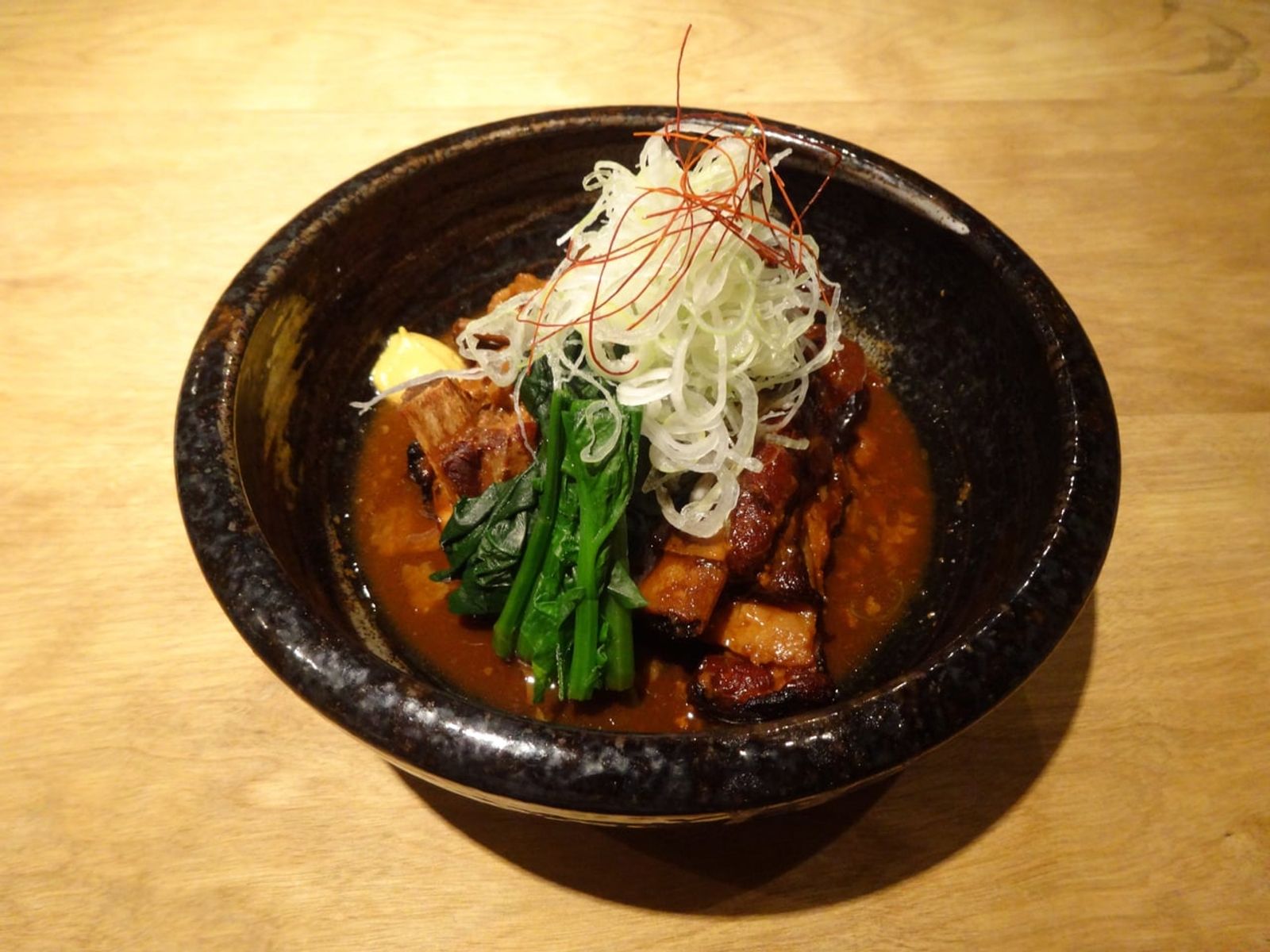
Satsuma tonkotsu made with Kagoshima kurobuta · Photo: 聖石大戦ぶぅぶぅ / CC BY-SA 4.0 (Wikimedia Commons)
 JapanKagoshima
Kagoshima Kurobuta and Satsuma Tonkotsu: The Other Tonkotsu, a Stew of Bone-in Ribs
Order tonkotsu in Kagoshima and you may get not ramen but bone-in pork ribs slowly stewed with shochu, miso and brown sugar. Here is the story of pigs said to have come from Ryukyu, how the Berkshire kurobuta brand survived, and how to eat it all.
Why Kagoshima Ate Pork So Early
Even in Edo-period Japan, where eating meat was widely frowned upon, Satsuma (today's Kagoshima) is known for having raised and eaten pigs early on. According to Japanese Wikipedia, a 1546 report by the Portuguese captain Jorge Álvares already mentions pig-keeping at Yamakawa in Kagoshima. The origin most often cited for Kagoshima's pigs is Ryukyu, today's Okinawa. One account says pigs were brought back when the Satsuma domain invaded the Ryukyu Kingdom in 1609, and Japan's agriculture ministry likewise traces kurobuta to pigs brought from Ryukyu in the time of Shimazu Iehisa, the domain's 18th head. Another view holds that Ming Chinese who settled at Bōnotsu in the late 16th century spread pork-eating, so while the Ryukyu route is considered more likely, it is not proven.
Berkshire Blood and the Kagoshima Kurobuta Brand
Today, Kagoshima kurobuta means the Berkshire breed, which originated in England. According to Japan's agriculture ministry, local pigs were crossed with British Berkshires and improved in the Meiji era. The breed is known for roppaku, "six whites": white on its four feet, the bridge of its nose and the tip of its tail. A veterinarian named Sonoda Hyōsuke, who promoted feeding pigs sweet potatoes and fish scraps, is called the "father of Kagoshima kurobuta". From the 1960s, however, fast-growing white pigs took over, and by 1985 black pigs were just 3 percent of breeding sows. After a long debate in the 1970s over switching to white pigs, the governor of the day reportedly decided to keep the black pig. A certification system followed in April 1992, and the name "Kagoshima Kurobuta" was trademarked in 1999.
The Other Tonkotsu: A Stew of Bone-in Ribs
In Japan, tonkotsu usually brings to mind Fukuoka's pork-bone broth ramen, but Kagoshima has an entirely different local dish of the same name. Bone-in pork spare ribs are browned, doused with sweet potato shochu and cooked over high heat to burn off the alcohol, then simmered in water with daikon, burdock and konjac, and slowly stewed with barley miso and brown sugar. According to Japan's agriculture ministry, the shochu removes the pork's odour and tenderises the meat. The key flavour is Kagoshima's barley miso. Rice was scarce here, so barley miso was the norm; it is rich in koji, lower in salt and notably sweet. Brown sugar is added on top for a sweet-salty glaze, and one explanation says that sweetness was considered a way of showing hospitality to guests.
Samurai Field Cooking and Saigō Takamori
Satsuma-style tonkotsu is said to have begun as outdoor cooking by Satsuma samurai at hunting grounds and on battlefields. Japan's agriculture ministry and many guides repeat the story, but no old record directly confirming it has been verified, so treat it as tradition. People in Kagoshima like to add that Saigō Takamori, a leading figure of the Meiji Restoration, loved the dish. The English literature scholar and writer Yoshida Ken'ichi is said to have described tonkotsu as "rugged-looking, yet a delicate dish". It is home cooking with no particular season, appears in school lunches and varies from household to household. The same ministry website also introduces butamiso, pork cooked down with barley miso and sugar, as a Kagoshima dish.
Where and How to Eat It
You can try kurobuta and tonkotsu at local-cuisine restaurants and izakaya around Tenmonkan, Kagoshima City's main nightlife district, and near Kagoshima-Chūō Station. If a menu says とんこつ or 豚骨, it is often the stew rather than ramen, so check the photo or ask if unsure. To enjoy the pork itself, shabu-shabu, thin slices swished briefly in hot broth, and tonkatsu are especially popular with travellers. Many people describe the fat as sweet and clean, so the trick with shabu-shabu is not to overcook the meat. If you are drinking, sweet potato shochu, the same spirit used to cook tonkotsu, is a natural match. Even when a menu says 黒豚, whether it is certified brand pork varies by restaurant, so check the origin labelling if you are curious.