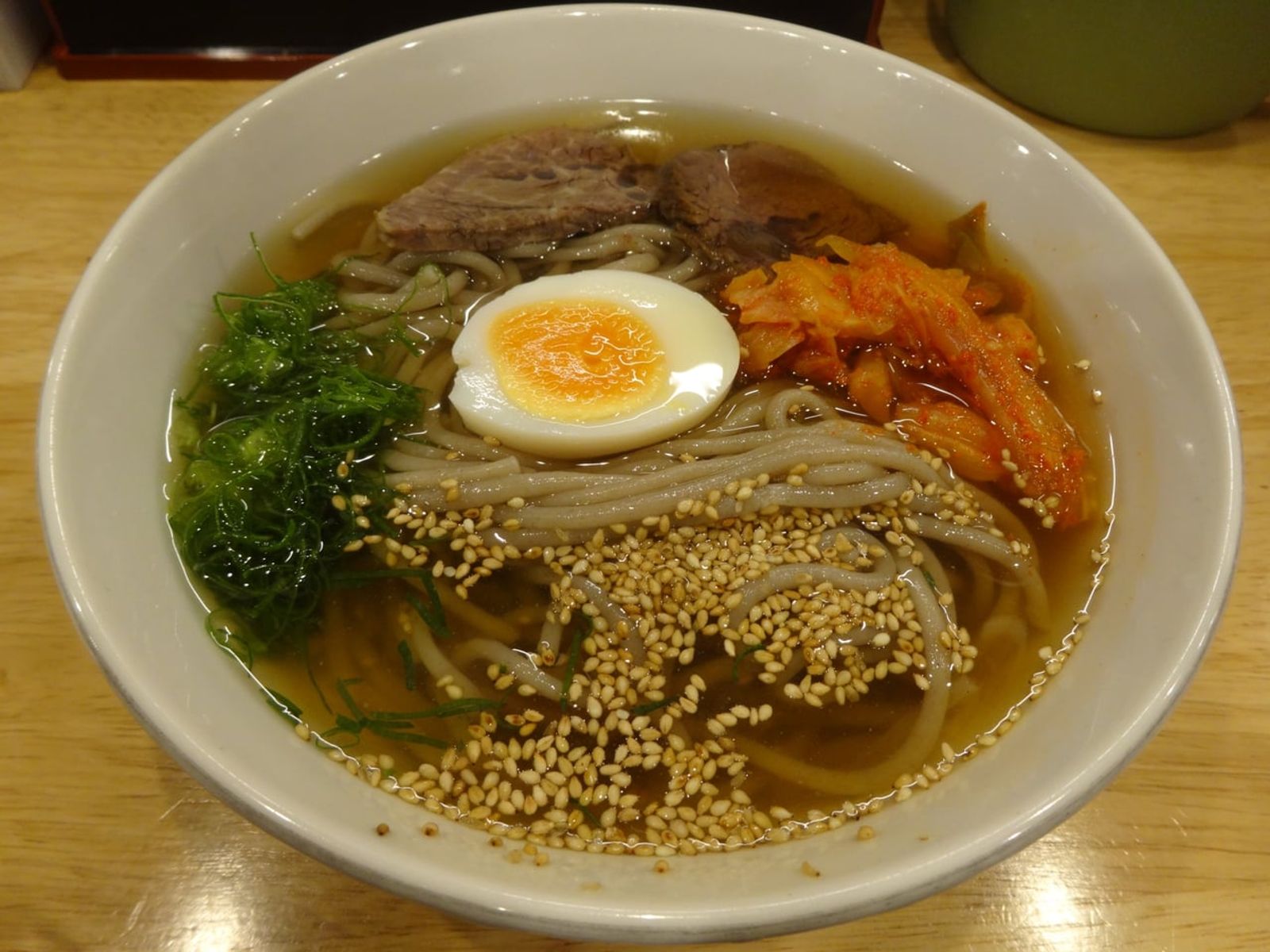
A bowl of Beppu reimen · Photo: 聖石大戦ぶぅぶぅ / CC BY-SA 4.0 (Wikimedia Commons)
 JapanBeppu
Beppu Reimen: The Cold Noodles Brought Home From Manchuria
Beppu, the hot spring capital, is said to have 60 to 70 places serving cold noodles. Here is how Korean-style naengmyeon, brought by people returning from Manchuria after the war, became Beppu reimen with Japanese broth and cabbage kimchi.
A Surprising Soul Food in a Spa Town
Beppu brings to mind hot springs and the Hell Tour, but among the foods locals call their soul food is cold noodles. Around 60 to 70 places in the city are said to serve them. For Korean visitors the interesting part is that these noodles have roots on the Korean Peninsula. Yet the bowl in front of you is quite different from Pyongyang or Hamhung naengmyeon. The broth tastes of Japanese seafood stock such as bonito, and the kimchi on top is often made from cabbage rather than napa cabbage. So Beppu reimen is better understood not as a Japanese copy of Korean naengmyeon, but as a local dish that grew its own way out of postwar migration and life in a hot spring town.
People Who Came Back From Manchuria
Beppu reimen dates back to the postwar years. After Japan’s defeat, many Japanese living in former Manchuria, today’s northeast China, returned to the home islands, and the accepted story is that those who settled in Beppu brought with them the cold noodles they had eaten there. Many people from the Korean Peninsula also lived in Manchuria, so the noodles they learned were Korean-style naengmyeon. The dish is said to begin with a shop that a cook returning from Manchuria opened in Beppu around 1950. Beppu is often described as a city that escaped heavy wartime damage, and as a spa resort it drew people and goods. Some see that mix of newcomers as the reason an unfamiliar dish could take root. Details about the earliest shops and people vary slightly between sources.
Reborn as a Japanese-Style Bowl
Once in Beppu, the noodles slowly adapted to local taste. Several guides describe today’s Beppu reimen as the result of using more wheat flour in the noodles, switching the broth to Japanese dashi, replacing pork with beef chashu and swapping napa cabbage kimchi for cabbage kimchi. The noodles are usually based on wheat flour, buckwheat flour and starch. The broth is clear and light with a seafood base; dongchimi radish water or rich meat stock as in Korea is rare. Still, there is no strict definition. Some shops use napa cabbage kimchi or pork chashu, and every kitchen has its own broth. Think of buckwheat noodles, Japanese stock, cabbage kimchi and beef as common traits rather than rules.
Specialist Shops vs. Yakiniku Restaurants
Beppu reimen is usually divided into two camps. Specialist reimen shops serve thick, chewy noodles with cabbage kimchi, sometimes still called by its Korean name, yangbaechu kimchi. Yakiniku restaurants, on the other hand, tend to serve smooth, medium-thin noodles with napa cabbage kimchi. Ordering cold noodles to finish after grilling meat works much as it does in Korea, so Korean travelers will find the rhythm familiar. Many Beppu shops also offer onmen, the same noodles in hot broth. It is a good choice in winter when cold soup feels like too much, or for a light meal after warming up in the baths. Ordering one cold and one hot bowl at the same shop is a fun way to compare the broth.
Where and How to Eat It
Since fiscal 2009, the Beppu Reimen Project has promoted the noodles as a local specialty, producing maps and an official website. The shops are spread across the city, including around Beppu Station and the seaside Kitahama area. Specialist shops can have lines at lunchtime, so go a little early or late in the afternoon. The yakiniku camp is best enjoyed in the evening with grilled meat. When your bowl arrives, sip the broth on its own first to taste the Japanese stock. Stirring the kimchi in gradually makes it spicier, and some shops provide vinegar or mustard to add as you like. Cold noodles are often thought of as summer food, but in Beppu people eat them all year round.