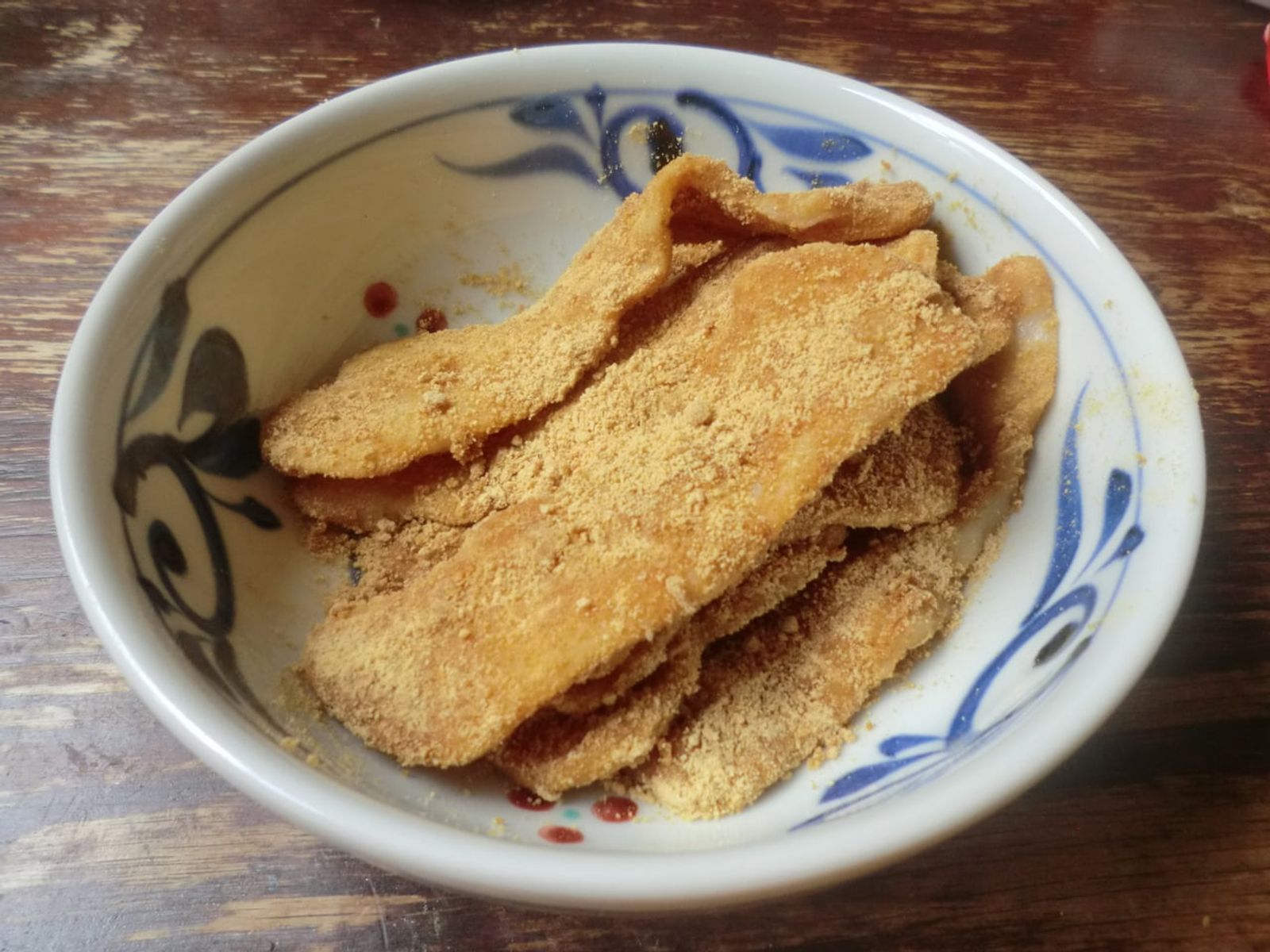
Oita’s yaseuma coated in kinako · Photo: Nissy-KITAQ / CC BY-SA 3.0 (Wikimedia Commons)
 JapanYufuin
Yaseuma: The “Yase, Uma” Legend of Yufu’s Hasama and Oita’s Soybean-Flour Sweet
Yaseuma is a local Oita sweet of flat wheat dough, boiled and coated in roasted soybean flour and sugar. Its odd name, which sounds like “skinny horse,” is said to come from a Heian-era legend of Hasama, part of the same Yufu City as Yufuin.
What Yaseuma Is
Yaseuma is a traditional sweet from Oita Prefecture. Wheat dough is stretched by hand, not cut, into long flat strips, boiled, and then generously coated with a mix of roasted soybean flour (kinako) and sugar. The chewy dough and nutty, sweet powder may remind Korean visitors of injeolmi, but this is wheat noodle rather than rice cake. The interesting part is that it uses the same dough as dango-jiru, Oita’s miso noodle soup. Put the flat strips into miso soup with vegetables and you have a meal; boil them and roll them in kinako and you have a snack. It is a dish that shows how life worked in Oita, where rice was scarce and wheat plentiful. Variations include roasted barley flour (hattaiko) instead of kinako, a side of sweet bean paste, or brown sugar mixed in.
The “Yase, Uma” Legend of Hasama
The best-known explanation for the name is a legend from the former town of Hasama, now part of Yufu City. In the Heian period, the story goes, a young noble from Kyoto named Fujiwara no Tsurukiyomaro came down to Bungo Province and lived in hiding in a Hasama village. The woman who looked after him came from Yase, north of Kyoto, so she was called Yase. A devout woman, she often took him to pray to the Jizo statue at a local temple, and when he was hungry she kneaded wheat flour, stretched it thin, boiled it and coated it in kinako for him. Whenever he wanted it, Tsurukiyomaro would beg, “Yase, uma, Yase, give me uma!” Here uma does not mean horse; it is said to be baby talk for food, like “num-num.”
Other Theories: Horse-Shaped Sweets and a Skinny Horse
Besides the Hasama legend, there are a few other theories about the name. One says there was once a sweet made of rice flour shaped like a horse, which gradually changed into today’s yaseuma. Another is a folk tale that people ate the wheat meant for the horses, leaving the animals thin, hence “skinny horse.” Which theory is right depends on the source, and no definitive record survives. Interestingly, Japanese dialect dictionaries list foods with similar names in other regions such as Fukushima, Niigata, Nagano, Shizuoka, Hyogo and Chiba. Most of those, however, are rice-flour sweets or dumplings offered at Buddhist and seasonal rites.
When It Is Eaten: Obon and Temple Rites
Yaseuma is eaten as an everyday snack, but it was originally tied closely to Buddhist and seasonal observances. In Oita the custom of offering it at Nehan-e, which marks the Buddha’s passing, at Obon and at Tanabata is still widespread. On March 21, a day associated with Kobo Daishi (Kukai), people often offer salted yaseuma, while on August 14 during Obon it is commonly coated in kinako mixed with brown sugar. At the temple in Hasama where the legend is set, yaseuma is reportedly still made on August 23 for the Segaki rite, a memorial service for ancestors and wandering spirits held around Obon. A sign in the grounds tells the story of the “birthplace of yaseuma.”
Where to Buy It and How to Enjoy It
Yaseuma is so common in Oita that it is made at home, sold in shops and supermarkets, and sometimes served in school lunches. One thing to know: Oita also has a separate packaged confection sold under the yaseuma name. It is a souvenir sweet that borrows its name from the traditional dish and differs in shape and taste from the original flat wheat dough rolled in kinako. If you want the traditional snack, check the description or photo on the package. It pairs well with hot green tea, and in summer it stays chewy even chilled. Have dango-jiru for lunch in Yufuin and yaseuma for dessert to compare the two faces of the same dough.