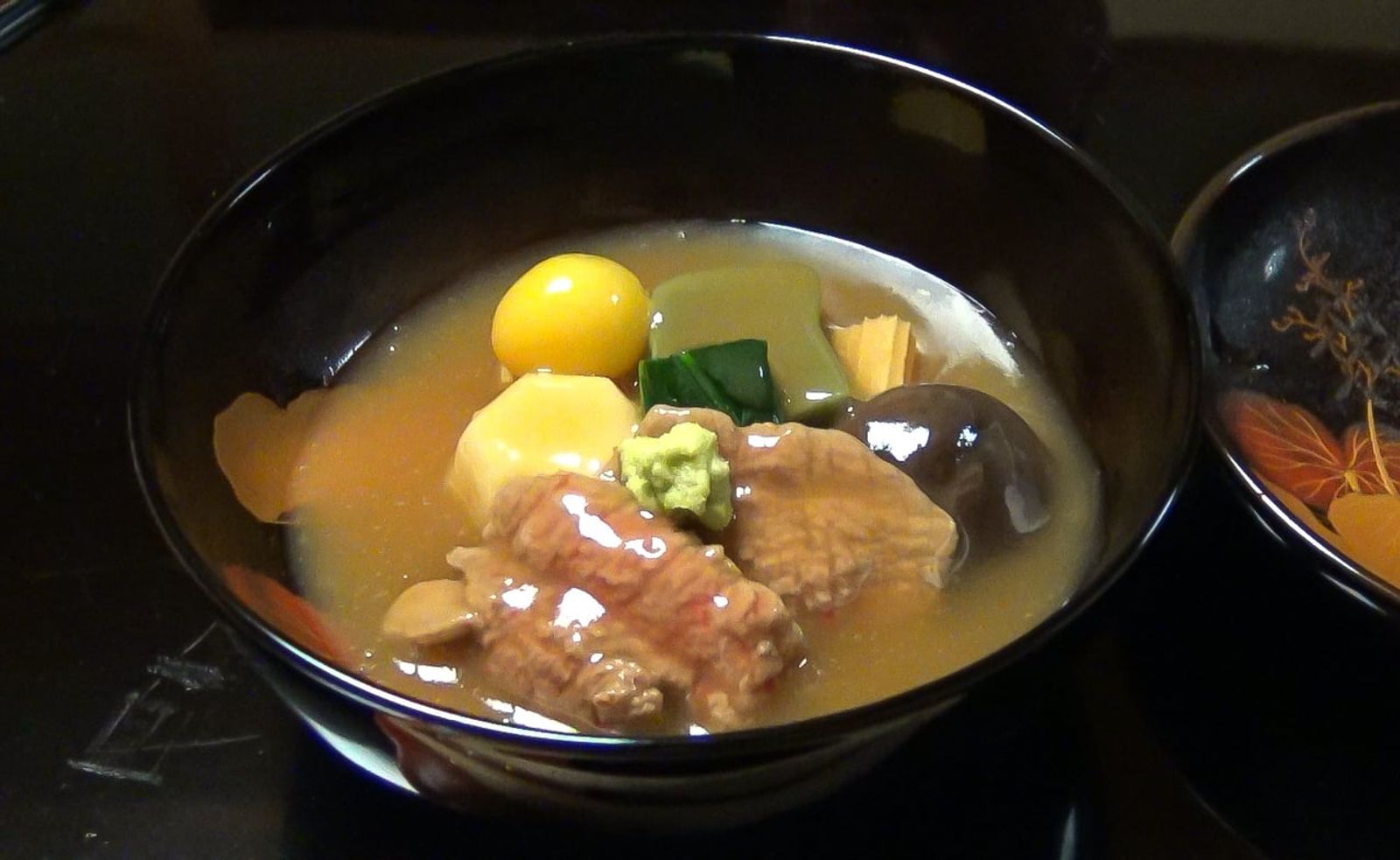
Jibuni in Kanazawa · Photo: Asacyan / CC BY-SA 4.0 (Wikimedia Commons)
 JapanKanazawa
Jibuni: Kanazawa's Signature Duck Stew and the Many Stories Behind Its Name
Flour-dusted duck simmered in a lightly sweet soy broth, served with Kanazawa's own sudare-fu wheat gluten, shiitake and greens, and a dab of wasabi: that is jibuni. Here is its history going back to the Kaga domain, the competing theories about its name, how to eat it and where to find it.
What Jibuni Is
Jibuni (治部煮, also written じぶ煮) is the signature local dish of Kanazawa in Ishikawa Prefecture and a symbol of Kaga cuisine, the food culture inherited from the old Kaga domain. Duck (or sometimes chicken) is thinly sliced, dusted with flour and simmered in stock seasoned with soy sauce, sugar, mirin and sake, together with sudare-fu, a wheat gluten specialty of Kanazawa, shiitake mushrooms and greens such as Japanese parsley or spinach. The flour has a purpose. It seals in the flavor of the meat and gives the broth a gentle body so it clings to everything in the bowl. The condiment is wasabi, whose sharp aroma cuts through the slightly sweet broth. Jibuni is listed among the Ministry of Agriculture's 100 best local dishes of rural Japan, and in haiku it is a seasonal word for winter.
Where the Name Comes From: A Sound or a Person?
There are several theories about the name jibuni and no settled answer. The best known says it comes from the "jibu-jibu" sound of the pot as it simmers. However, the 1643 cookbook usually cited as evidence, Ryori Monogatari, actually writes it as "shifu-shifu." Another theory holds that it changed from "jubu" (熟鳧), a word meaning stewed duck. There is also a story that Okabe Jibuemon, a provisions officer under Toyotomi Hideyoshi, brought it back from Korea, but it is treated as an unsourced tale. Others say that Takayama Ukon, a Christian daimyo, introduced a European-style dish while staying in Kaga around 1588, or that a Portuguese dish brought by missionaries was adapted to Japanese taste. Sources differ, so think of these as stories to enjoy rather than facts.
From a Kaga Domain Cookbook to the Emperor's Table
The recorded history of jibuni begins in the Kaga domain during the Edo period. A cookbook left by a Kaga domain cook in the early 18th century, Ryori no Shiori, describes a dish called "mugitori" (麦鳥) that resembles today's jibuni. The name can be read as "bird with wheat flour." By the early 19th century dishes like this had come to be called "jubu," which is thought to have led to today's "jibu." It was loved by samurai households and townspeople alike in the Kaga domain and served to honored guests. There is even a record that on October 25, 1947, when Emperor Showa stayed at Awara Onsen in neighboring Fukui Prefecture, he was served jibuni made with young chicken. For centuries, it has held its place as the region's dish for hospitality.
Sudare-fu and the Shallow Lacquer Bowl
One ingredient jibuni cannot do without is sudare-fu. It is fresh wheat gluten (nama-fu) kneaded with rice flour, wrapped in a bamboo blind (sudare) and boiled, so the surface keeps a striped pattern from the blind. This Kanazawa specialty is said to have begun when cooks of the Kaga domain added rice flour to make a gluten that would not fall apart when simmered. Chewy yet spongy, it soaks up plenty of broth, and some people even say they like it more than the duck. The bowl is part of the show, too. Jibuni is often served in a shallow lacquer bowl such as Yamanaka lacquerware from Ishikawa, and some places use bowls decorated with gold maki-e designs. The duck, sudare-fu, shiitake and greens are arranged neatly by color on top of the thickened broth, with wasabi on one side, making a bowl worthy of Kanazawa, a city known for its crafts.
Where and How to Eat It
Jibuni often appears as one course in a Kaga cuisine meal at Kanazawa's ryotei and Japanese restaurants, and around sightseeing areas such as Kenrokuen, Kanazawa Castle and the Higashi Chaya district you can also order it as a set meal or on its own. It sometimes sits beside Kanazawa oden on hotel breakfast buffets, and some places serve it over rice as a jibuni bowl. When you eat it, try dissolving a little wasabi into the broth or placing it on the meat to change the flavor as you go. Do not leave the thick broth; spoon it up with the sudare-fu. It is said to be best in winter, duck season, but most places serve it all year. Some restaurants use chicken instead of duck, so if you want duck, check the ingredients on the menu.