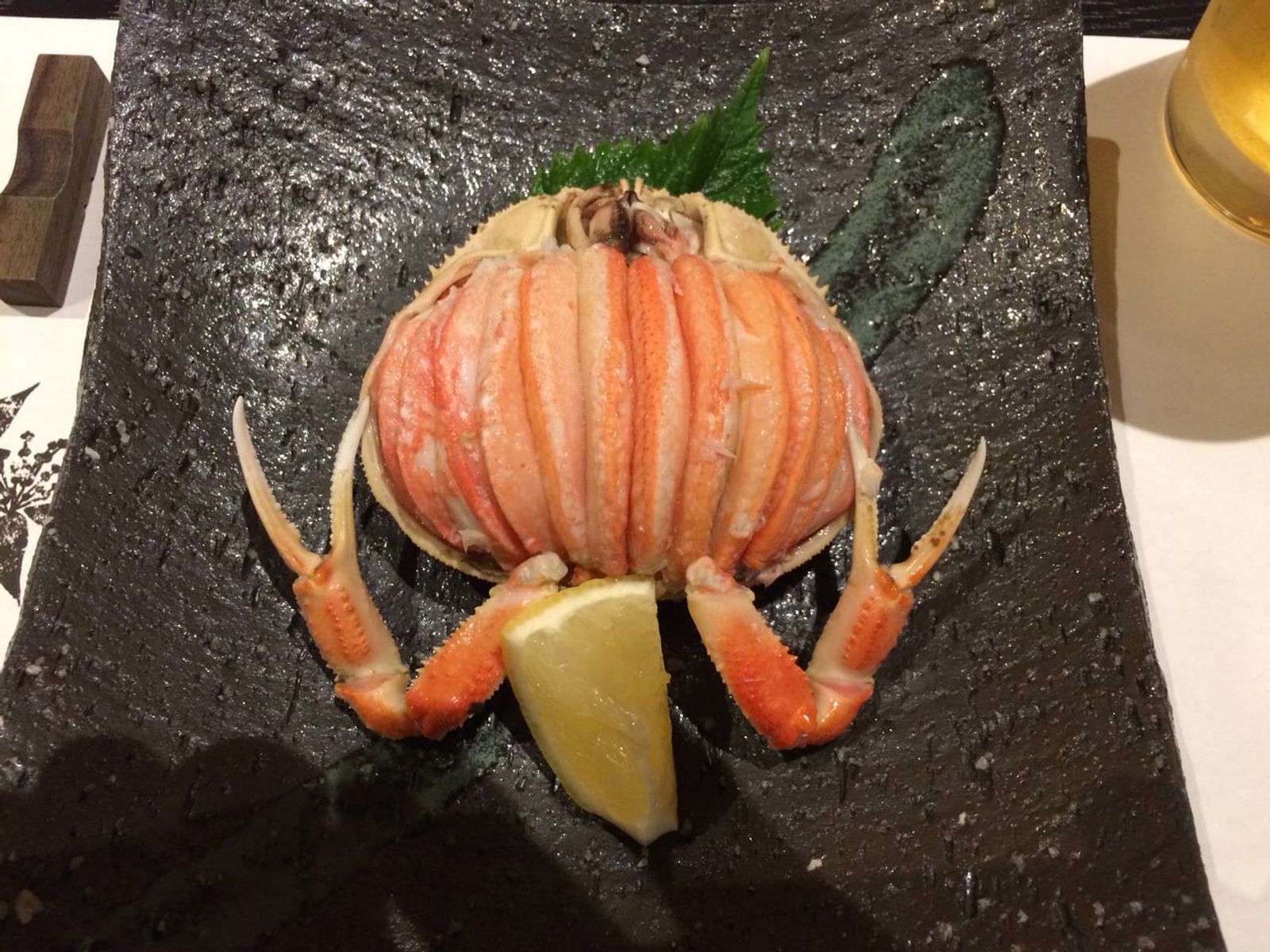
Kobako crab (female snow crab) · Photo: pelican from Tokyo, Japan / CC BY-SA 2.0 (Wikimedia Commons)
 JapanKanazawa
Kano Crab and Kobako Crab: A Guide to Kanazawa's Winter Snow Crab Season
Winter in Kanazawa begins with snow crab. Here is the difference between the blue-tagged male "Kano crab" and the roe-filled female "kobako crab," when you can eat each, how their names differ from snow crab elsewhere in Japan, and how to enjoy them at Omicho Market.
Kano Crab: The Name for Male Snow Crab
Snow crab (zuwaigani) caught in the Sea of Japan goes by different names depending on where it is landed. In Ishikawa Prefecture, the brand name for male snow crab is Kano crab (加能ガニ). It takes "Ka" from Kaga and "No" from Noto, the region's two old provinces, and was chosen through a public naming contest on November 1, 2006. Not every male qualifies. Only crabs with a shell at least 9 cm wide and well filled with meat get the name, marked by a blue tag on the leg that also shows the port where the crab was landed. Male snow crab from neighboring Fukui, called Echizen crab, wears a yellow tag, and Matsuba crab from Tottori wears a white one, so at the market the tag color alone tells you which waters a crab came from.
Kobako Crab: The Female That Carries Roe
In Ishikawa, female snow crab is called kobako crab (香箱ガニ), or just "kobako." There are several theories about the name: that the crab looks like a small box, that it comes from "kobako" (子箱) meaning a female carrying eggs, or that it holds the fragrance of the Sea of Japan. Kobako are much smaller than males, but they are prized for the immature orange roe inside the shell, called uchiko, and the mature eggs carried under the belly, called sotoko. The appeal is tasting dense, chewy uchiko, popping sotoko and rich crab innards all at once. Female crabs have regional names too: seiko crab in Fukui, seko crab in Hyogo, koppe crab in Kyoto, and oya crab in Tottori and Shimane.
When to Eat It: The Season Opens November 6
Snow crab fishing in Ishikawa opens every year on November 6. On opening day the first auction is held and crabs go straight onto the stalls of Kanazawa's Omicho Market, a sight that tells the city winter has arrived. Bad weather can delay the boats, though; in 2023 the first auction took place three days late, on November 9. The season differs for males and females. According to local guides, male Kano crab can be caught until March 20 of the following year, but female kobako only until December 29, so you have less than two months to try kobako. That is exactly why it is so cherished as a rare taste of winter. There are also top-tier brands: males that pass strict standards are called "Kagayaki" (輝), and females "Kagayaki-hime" (輝姫).
How to Eat It
The classic is yudegani, crab boiled in salted water. With a boiled male, the joy is pulling long, thick strands of meat from the legs, and the crab innards (kani miso) inside the shell are eaten as they are or used as a dip for the meat. With kobako, the fun is opening the shell and spooning up the inner roe, innards and the outer eggs from the belly together. Because the legs are thin and fiddly, many places pick out the meat in advance and pack it back into the shell for you. Kobako with the meat packed into the shell is also used for sushi and rice bowls, and Kanazawa's oden bars simmer it in their broth as the winter-only "kanimen." Males are large and expensive but generous with meat; females are small and relatively affordable, with rich roe and innards. Try a little of both to really taste the difference.
Enjoying Crab at Omicho Market
The easiest place to meet snow crab in Kanazawa is Omicho Market, known as "Kanazawa's kitchen." Once the season opens, stall after stall lines up boiled and live crabs, and restaurants in and around the market serve crab rice bowls, set meals and kobako dishes. Winter weekends get crowded from the morning, so visiting on a weekday or early in the day lets you browse at leisure. When buying a male, check the blue leg tag and port name to confirm it is Ishikawa-landed Kano crab. For overseas travelers, carrying raw or boiled crab onto a plane can be difficult and import rules differ by country, so eating it on the spot is the surest option. Prices vary a great deal with size, condition and that day's catch, so always check the price tag at the stall before choosing.