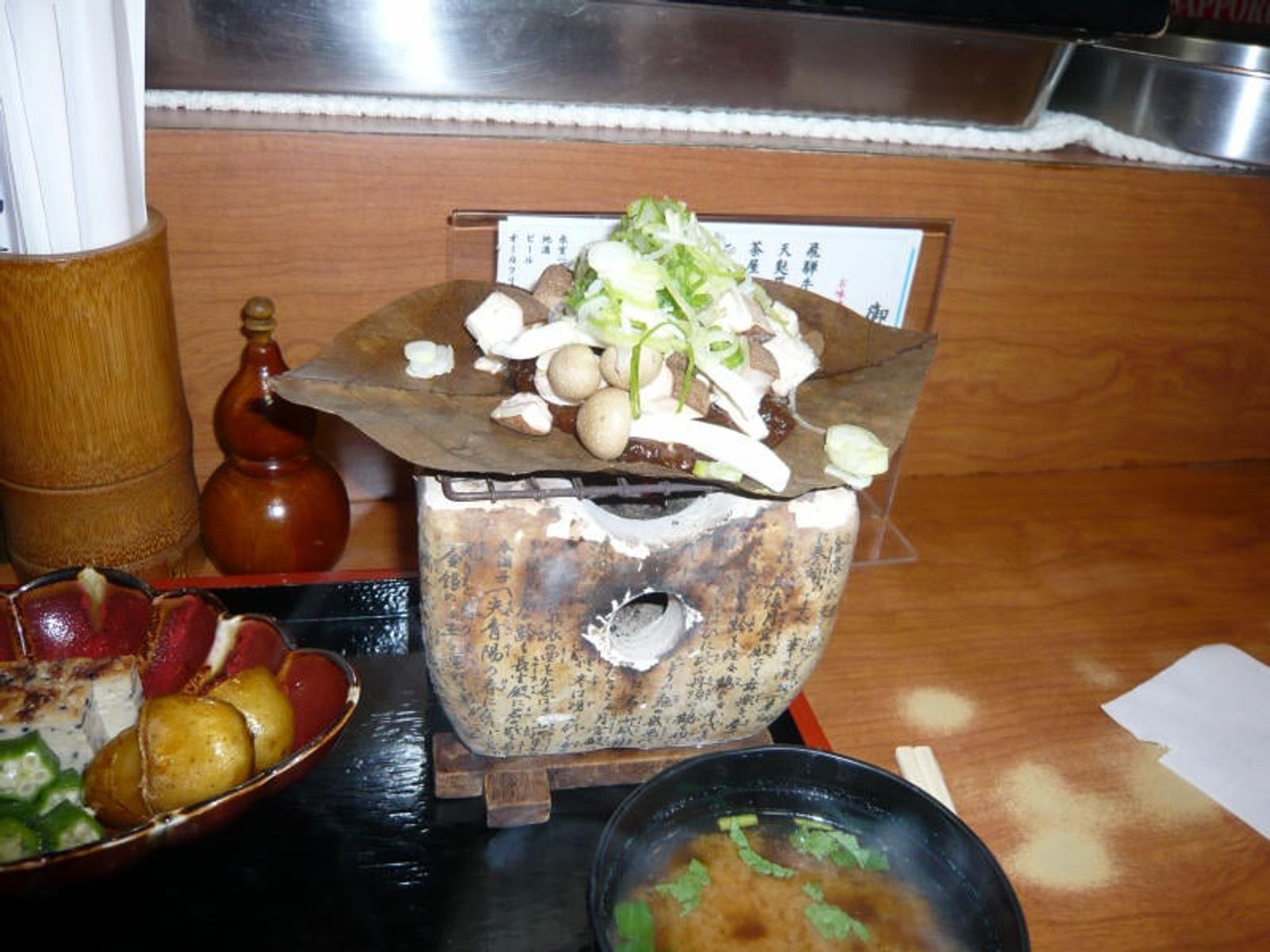
Hoba miso grilling on a magnolia leaf over a brazier · Photo: Opqr / CC BY-SA 3.0 (Wikimedia Commons)
 JapanTakayama
Hoba Miso: Miso Grilled on a Dried Magnolia Leaf, the Star of a Hida Ryokan Breakfast
Stay at a ryokan in Hida-Takayama and breakfast may arrive with a small charcoal brazier and a large dried leaf. The miso sizzling on that leaf is hoba miso. Here is how it is said to have grown out of harsh winters, what the leaf does, how to enjoy it and where to find it.
What Hoba Miso Is
Hoba miso is a local dish of the Hida region in northern Gifu Prefecture. Homemade miso is mixed with chopped green onion and mushrooms such as shiitake, spread on a dried leaf of the hoonoki (Japanese bigleaf magnolia), and grilled over charcoal or a small tabletop brazier. As the miso warms and starts to bubble, the leaf releases a gentle fragrance, the mushrooms and onions cook, and the miso toasts slightly at the edges. The basic way to eat it is spooned over warm rice, as part of a simple meal with a few side dishes. Grilling meat or fish on top of the miso is also popular, and hoba miso topped with thin slices of Hida beef is a standard menu item at many restaurants in the region. It appears especially often at breakfast in Hida's ryokan and hotels.
Said to Be Born of Harsh Winters
No one knows exactly how hoba miso began, but it is widely said to have grown out of life in Hida, where winters are bitterly cold. Hida-Takayama, ringed by mountains, was reportedly so cold in winter that barrels of preserved miso and pickles froze solid. One theory says it started when frozen pickles were placed with miso on a dried leaf and warmed over the irori hearth. A multilingual explanation by Japan's tourism authorities adds that as the pickles thawed, the moisture in the miso kept the leaf from catching fire. There is also a simpler tradition of just warming miso on a leaf at the winter hearth, and another theory that it came from forest workers using the leaves as plates, so sources differ. Later, with the growth of tourism, it developed into a dish for welcoming guests.
Why a Magnolia Leaf?
Hoba means the leaf of the hoonoki, the Japanese bigleaf magnolia. A single leaf can reach 30 to 40 cm long, making it easy to use like a plate, and it is described as water-repellent and sturdy. The leaves are used dried, and on the fire they do not burn easily thanks to the moisture in the miso. The leaf has a distinctive scent that it passes to the miso as it grills. Magnolia leaves have long been believed to keep germs at bay, and there are stories of them being used as lunch plates during farm work. It is best to take such claims as folklore rather than proven fact. In the Gifu area the leaves are also used to wrap rice cakes and sushi, so they are a familiar ingredient in the local food culture.
How to Enjoy It
When hoba miso arrives at a ryokan breakfast, the staff usually light the brazier for you. Once the miso warms and starts bubbling from the edges, use your chopsticks to mix the onions and mushrooms into the miso so everything cooks evenly. Leave it too long and the miso burns and the leaf dries out, so the best moment is when the aroma rises and the miso just begins to toast. Eating it is simple. Spoon a little of the grilled miso onto warm rice. It is strongly salty, so the trick is not to pile on too much at once. If yours has Hida beef on top, dip the meat in the miso as it cooks. The leaf itself is not eaten, so just leave it. It stays hot even after the flame goes out, so be careful not to touch it.
Where to Eat It and Taking It Home
The most natural place to meet hoba miso is breakfast at a ryokan in Hida-Takayama and the nearby hot spring towns. Even if you are not staying overnight, local-cuisine restaurants and set-meal places in Takayama's old town serve it at lunch or dinner, and a hoba miso set with Hida beef is a regular on many menus. If you want to enjoy it at home, browse Takayama's morning markets, souvenir shops and stores around the station. Dried magnolia leaves and miso for hoba miso are often sold together as a set. At home, guides suggest you can grill it on a frying pan or hot plate lined with aluminum foil, even without a brazier. Miso and plant leaves may be subject to import rules depending on the country, so check your home country's quarantine regulations before taking them abroad.