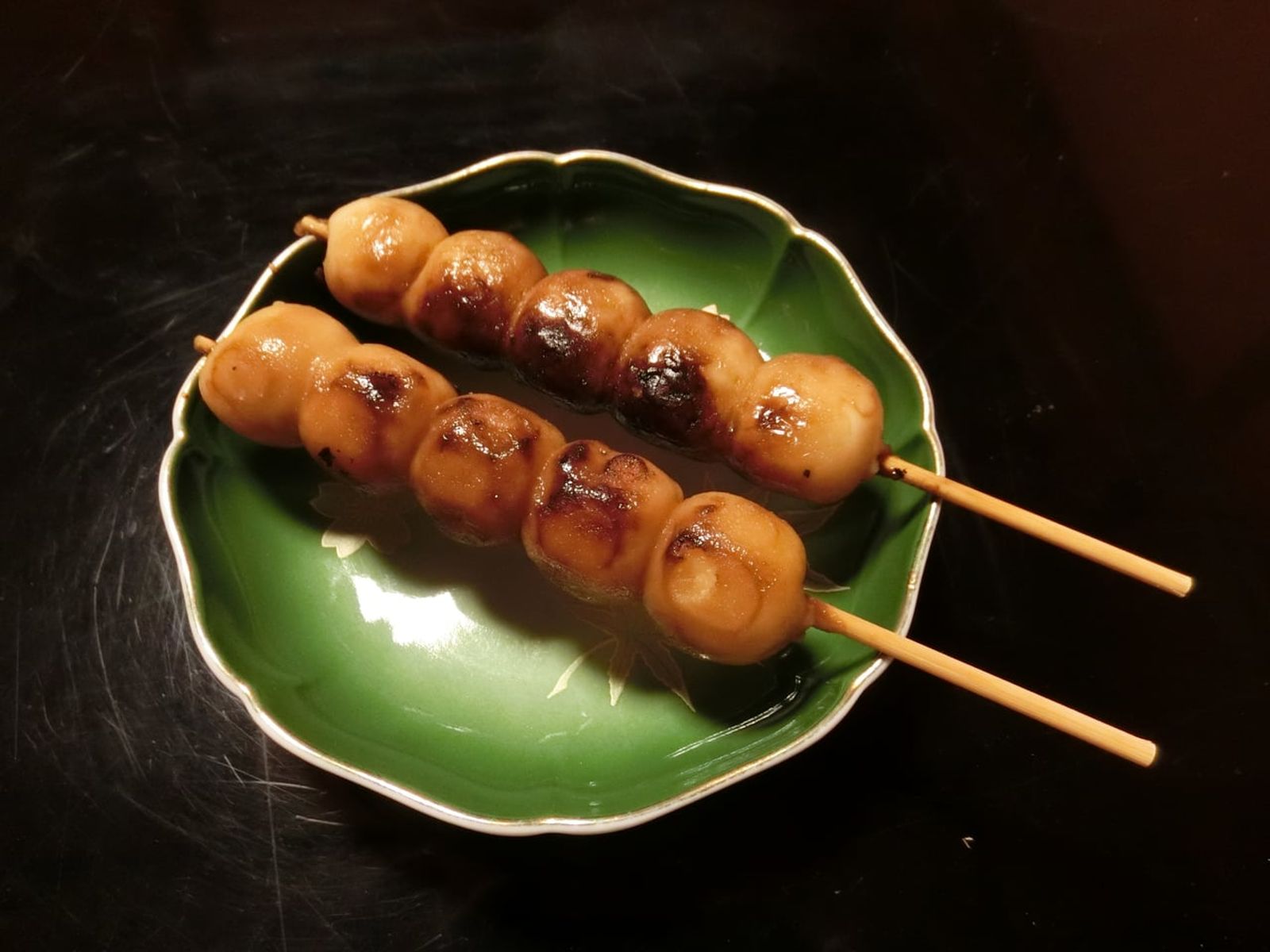
Takayama midarashi dango, grilled with soy sauce only · Photo: 大野 一将 / CC BY-SA 4.0 (Wikimedia Commons)
 JapanTakayama
Hida's Midarashi Dango: Savory Soy-Glazed Rice Dumplings, and How They Differ From Kyoto's Mitarashi
The skewered dumplings grilling over charcoal on Takayama's old streets are not the sweet mitarashi dango most people know. They are "midarashi," brushed with soy sauce and toasted until savory. Here is how they differ from Kyoto's mitarashi, how they are made, their roots as a preserved food and tips for buying them.
A Dumpling That Isn't Sweet: "Midarashi"
In Japan, mitarashi dango usually means dumplings drenched in a glossy sweet-and-salty brown sauce. The midarashi dango of Gifu's Hida region is different. Dipped in a mainly soy-based sauce and grilled, it tastes more of toasted soy and salt than sweetness. Even the name is slightly different. In Hida it is "midarashi" rather than "mitarashi," and people often drop the word "dango" and just say "midarashi." First-timers expecting something sweet are sometimes surprised, but think of grilled rice cake with soy sauce and you will get the idea. Similar dumplings are found in southern Gifu and around Nagoya, where they may be called "mitarashi."
How It Differs From Kyoto's Mitarashi
The familiar mitarashi dango is said to come from festivals at Shimogamo Shrine in Kyoto. Dumplings made by parishioner families as offerings were sold at shops within the shrine grounds and became a specialty, and one theory says their shape imitates the bubbles rising from the Mitarashi Pond (御手洗池) in the shrine's forest. Interestingly, in Kyoto too they were originally brushed with soy sauce and grilled. Later they came to be covered with a kudzu-starch sauce, and one theory says a soy-and-brown-sugar sauce devised in the Taisho era spread nationwide. In other words, the sweet mitarashi we know today is a relatively recent form, and Hida's soy-only midarashi is arguably closer to the older style.
How It Is Made and How It Tastes
Midarashi dango are made by kneading rice flour with cold or hot water, steaming the dough and shaping it into small balls about 3 to 5 cm across. It varies by shop, but usually five go on each skewer. They are first grilled lightly over the fire, then dipped in the soy sauce and grilled again. When the repeated grilling and dipping leaves golden char marks on the surface and the aroma of toasted soy rises, they are ready. The outside turns slightly crisp where the soy has caramelized, while the inside keeps the chewy texture of rice cake. Because the sauce soaks into the surface rather than dripping like a glaze, they are easy to eat on the go. They are best straight off the charcoal and firm up as they cool, so eat them right after buying.
It Began as a Preserved Food, Not a Snack
Today it is loved as a street snack in tourist areas, but Hida's midarashi is said to have originally been made as a preserved food rather than a sweet. In Hida, with its deep mountains and long winters, grilling rice-flour dumplings and coating them in soy sauce was a practical way to make food that would keep. The method is said to have survived unchanged since before the abolition of the feudal domains in 1871, so one appeal of Hida midarashi is that you can still taste an old form from before sweet sauces spread. Shops are especially numerous in Takayama and neighboring Hida City (formerly Furukawa), and long-running shops grill them the same way generation after generation. It is not a flashy taste, but the simplicity of using only rice and soy sauce brings to mind the everyday life of the Hida people.
Where to Buy Them
Midarashi dango are easy to find in the so-called Sanmachi area of Takayama's old town, the preserved historic streets of Kami-Sannomachi, Kami-Ninomachi and Kami-Ichinomachi, and in front of Takayama Jinya, the former government office. Many small stalls and shopfront braziers grill them over charcoal and sell them by the skewer, perfect for a quick bite while strolling the old streets. Some shops re-grill them when you order, so a short wait gets you a warm one. Freshly grilled dumplings are very hot, so take them one at a time. Hold the skewer upright so the soy sauce does not get on your hands or clothes, and drop the finished skewer in the bin the shop provides. Many travelers pair them with Takayama ramen and Hida beef skewers for a Takayama street-food tour.