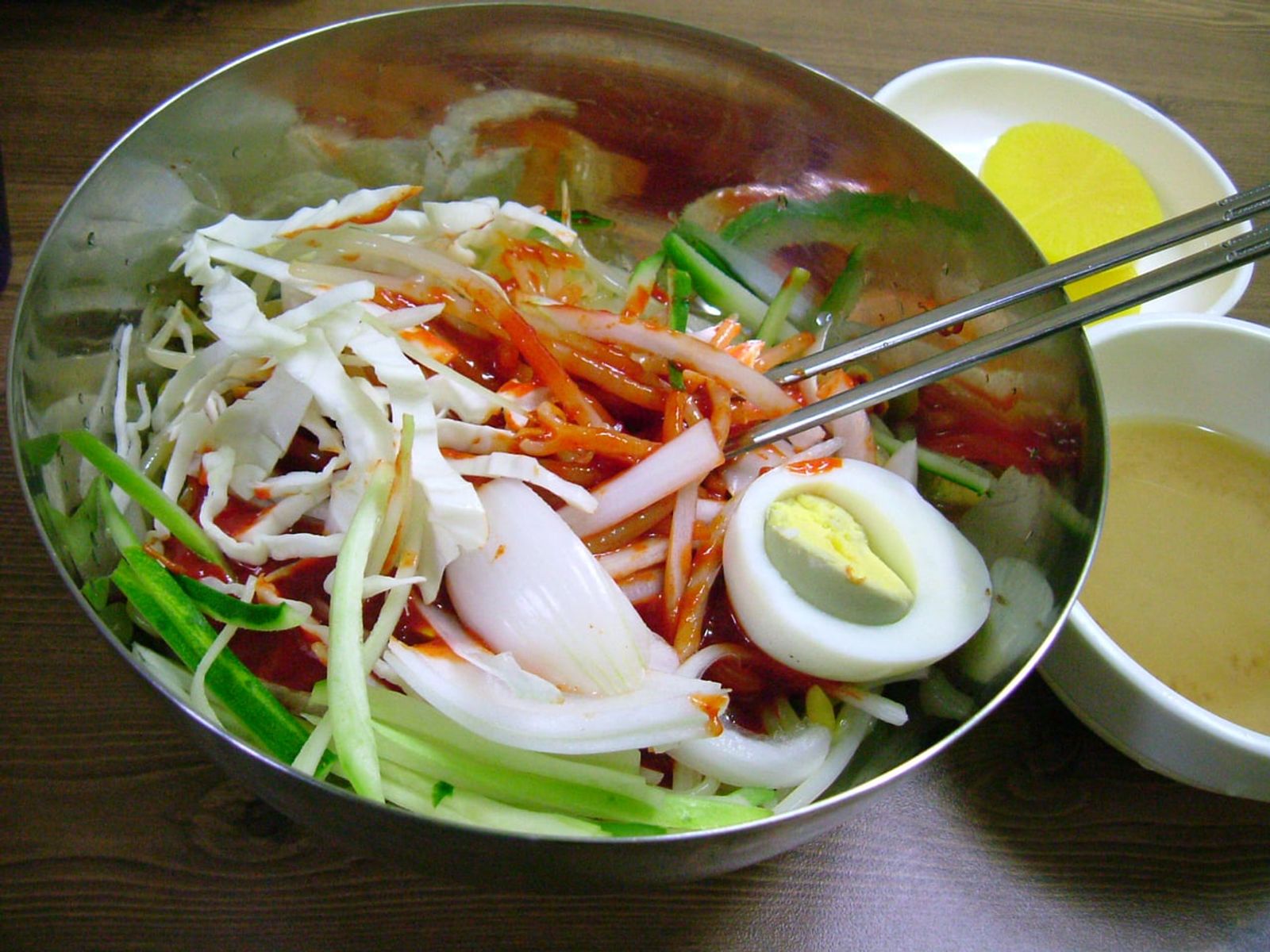
Jjolmyeon topped with vegetables · Photo: keizie / CC BY 2.0 (Wikimedia Commons)
 KoreaIncheon
Jjolmyeon: The Chewy Noodles Said to Have Been Born From a Mistake in Incheon
Thick, springy noodles tossed with fiery gochujang sauce and crunchy vegetables, jjolmyeon is a fixture on Korean snack-bar menus. Here is the story of its 1970s Incheon birth, the doubts around it, the snack-bar culture of Dong-Incheon, and how to mix it right.
What Is Jjolmyeon?
Jjolmyeon is a mixed noodle dish built around noodles that are, as the name says, jjolgit, or chewy. Thick, springy noodles made from wheat flour and starch are boiled and rinsed in cold water, then topped with a sweet, sour and spicy sauce of gochujang, vinegar and sugar plus vegetables such as bean sprouts, cabbage, cucumber and carrot. Half a boiled egg on top is the usual finish. The noodles are much thicker than naengmyeon and far chewier than ordinary noodles, which makes them fun to eat. Today you can find jjolmyeon next to gimbap and tteokbokki in snack bars all over Korea, but the story that it began in Incheon is widely told. In 2014 Incheon even made jjolmyeon one of the themes of a "Noodle Town" in Jung-gu, alongside jjajangmyeon, kalguksu and naengmyeon.
The Story of a Noodle Factory "Mistake"
The best-known origin story is a "mistake" said to have happened in the 1970s at a noodle factory in Incheon's Jung-gu. While making naengmyeon noodles, a worker fitted the wrong die on the extruder, and much thicker noodles came out. Rather than throw them away, the factory passed them to a nearby snack bar, which tossed them with gochujang sauce and vegetables, and jjolmyeon was born. The tale has become one of Incheon's signature food legends, to the point that the Incheon Municipal Museum notes that the factory known as jjolmyeon's birthplace is still there. However, the story's source is unclear, and critics point out that naengmyeon noodles and jjolmyeon noodles use different ingredients and methods, so simply changing the die would hardly produce jjolmyeon. The most accurate way to put it is that jjolmyeon is "said to have appeared in Incheon in the 1970s".
Dong-Incheon Snack Bars and Student Cravings
Jjolmyeon found fame in the snack bars around Dong-Incheon. In the late 1970s the streets of Dong-Incheon and Sinpo-dong were full of snack bars selling it, and students from nearby middle and high schools loved stopping in on the way home. The Incheon Municipal Museum has even called jjolmyeon "the national snack of the 386 generation", the Koreans who were students in that era. Dong-Incheon was then Incheon's busiest downtown, packed with snack bars, bakeries and cinemas where students gathered, and jjolmyeon spread beyond Incheon to the rest of the country along with that snack-bar culture. Around Sinpo-dong, dumpling shops also sold jjolmyeon, and the story goes that "dumplings and jjolmyeon" became almost a set meal. Long-running snack bars still survive around Dong-Incheon and Sinpo-dong today.
How to Mix It Right
When your jjolmyeon arrives, the key is to mix the noodles, sauce and vegetables thoroughly, right down to the bottom of the bowl. The noodles are thick and springy, so the sauce does not cling easily. Lift and drop them repeatedly with your chopsticks until everything is well combined. If it needs more sauce or is too spicy, some places let you adjust it with vinegar or sugar on the table, or you can ask the staff. Jjolmyeon is fairly spicy, so if you are sensitive to heat, the broth or pickled radish served alongside helps. Rather than eating jjolmyeon alone, many people order gimbap or dumplings too and alternate between them and the spicy, tangy noodles. If the noodles are too chewy to bite through, it is perfectly fine to ask for scissors and cut them once or twice.
Where to Try It
To get a feel for jjolmyeon's home turf, walk around Dong-Incheon Station on Seoul Subway Line 1 and the Sinpo-dong area near Sinpo Station on the Suin-Bundang Line. Old snack bars and dumpling shops still dot the streets, and Sinpo International Market, Incheon Chinatown and the old port-opening streets are all within walking distance, so it is easy to make a day of it. Many travellers plan an "Incheon noodle tour": lunch in Chinatown, home of jjajangmyeon, a stroll through the port-era streets, then a snack of jjolmyeon and dumplings in Sinpo-dong. A single portion of jjolmyeon is generous, so share with your companions if you want to try several things. Served cold, it is especially good in summer.