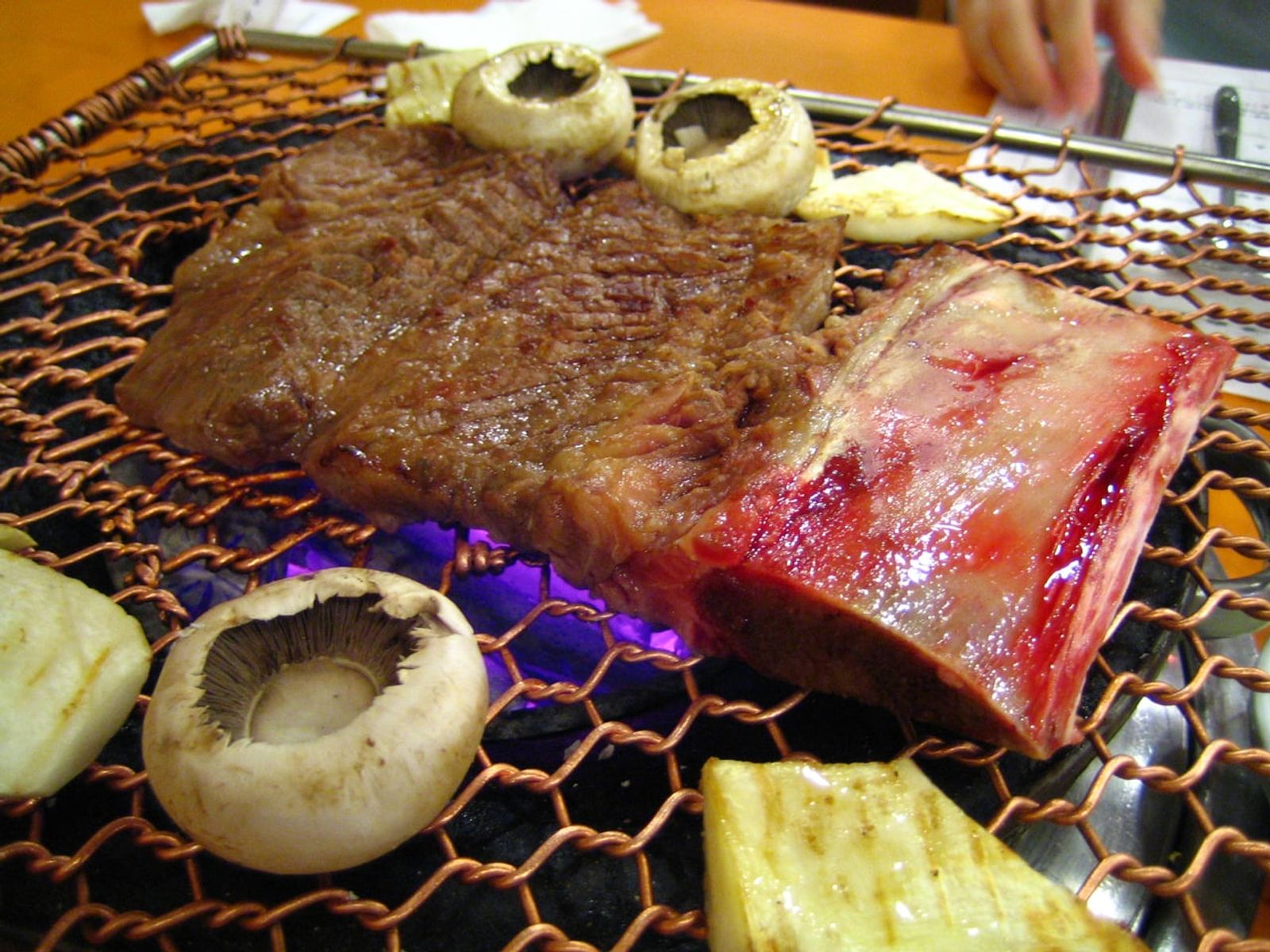
Beef ribs on a charcoal grill · Photo: ayustety (a flickr user) / CC BY-SA 2.0 (Wikimedia Commons)
 KoreaGyeonggi
Suwon Wang-Galbi: How Ribs Went From a Market Soup to the Charcoal Grill, Plus Pocheon Idong Galbi
In Gyeonggi Province, beef ribs mean Suwon for many people. Here is how Suwon's famously long "king ribs" came about, why the city made them an official local dish, how they differ from Pocheon's Idong galbi in the same province, and how to enjoy them.
What Makes Suwon Galbi Different
Suwon galbi is beef short rib cut in large pieces and grilled over charcoal. The rib bones are unusually long and big, which is why it is better known by the nickname "Suwon wang-galbi", or king ribs. The meat attached to the bone is scored and opened out so the seasoning soaks in, grilled whole, and cut with scissors just before eating. Traditional Suwon galbi is known for being seasoned with salt rather than soy sauce. For people used to ribs in a dark soy marinade, the salt seasoning is often said to bring out the natural flavour of the beef better. That said, many Suwon restaurants now serve soy-marinated ribs as well, and it is common to see menus that list "salt (saeng) galbi" and "yangnyeom (marinated) galbi" separately.
King Jeongjo's Fortress and the Cattle Market
Many sources trace Suwon's connection with beef back to King Jeongjo of Joseon. When he built Hwaseong Fortress in the late 18th century, large numbers of labourers and settlers gathered, and one story says the strictly controlled slaughter of cattle was specially permitted to feed them. Another says a large cattle market grew up in Suwon, rooting a culture of handling beef in the town. These accounts emphasise different things depending on the article, however, so it is hard to say Jeongjo's era led directly to today's Suwon galbi. It is best understood as background: Suwon has long been a place where cattle and beef came together. If you walk the walls of Hwaseong Fortress, a World Heritage Site, on the same trip, the story feels much more real.
Suwon Galbi's 1945 Start in Yeongdong Market
Today's Suwon galbi is generally said to have started at a restaurant that opened around Korea's liberation in 1945 on the rice merchants' street of Suwon's Yeongdong Market. It first sold ribs in haejangguk, a hearty soup, and around 1956 it began serving charcoal-grilled ribs, which became the Suwon galbi we know. In the 1960s, a rumour spread that President Park Chung-hee had eaten ribs there while visiting an agricultural research institute in Suwon, and the name "Suwon galbi" became known nationwide. The restaurant closed in 1979, but cooks who had learned its methods moved to rib restaurants in the eastern part of Suwon in the 1980s and kept the tradition alive. On 12 April 1985, the city of Suwon designated Suwon galbi an official local dish.
Same Province, Different Ribs: Pocheon Idong Galbi
Gyeonggi has one more place famous for ribs besides Suwon: Idong-myeon in Pocheon to the north, especially Jangam-ri, where rib restaurants cluster to serve "Idong galbi". It reportedly began when a rib restaurant opened there in the late 1960s, and because the area has many military bases, word spread among soldiers and the families visiting them. Idong galbi is scored and spread wide, pinned with toothpicks and grilled in a sweet marinade based on soy sauce and corn syrup. Portions are generous, with several ribs to a serving, and many people finish with dongchimi guksu, noodles in cold radish-kimchi broth. In one survey by Gyeonggi Province, Suwon galbi ranked first and Pocheon Idong galbi second among the province's signature foods.
How to Eat It and Where
At a Suwon rib restaurant, first decide between salt galbi and marinated galbi. If it is your first time, ordering salt galbi first to taste the beef itself and then adding marinated ribs is a safe approach. Staff often grill for you, so simply wrap the cut meat in lettuce or dip it in seasoned salt. Large restaurants may lay out around ten side dishes, including spicy marinated raw crab, and many people finish with naengmyeon or galbitang (rib soup). Rib restaurants are concentrated around Hwaseong Fortress and in eastern Suwon. A popular plan is to walk Hwaseong Haenggung Palace and the fortress wall trail, then have ribs for dinner. Beef ribs are fairly expensive, so check the weight and price of a serving beforehand, and go early on weekend evenings, when waits can be long.